


# AC vs. DC Circuit Breakers: What’s the Difference for Solar Panels?
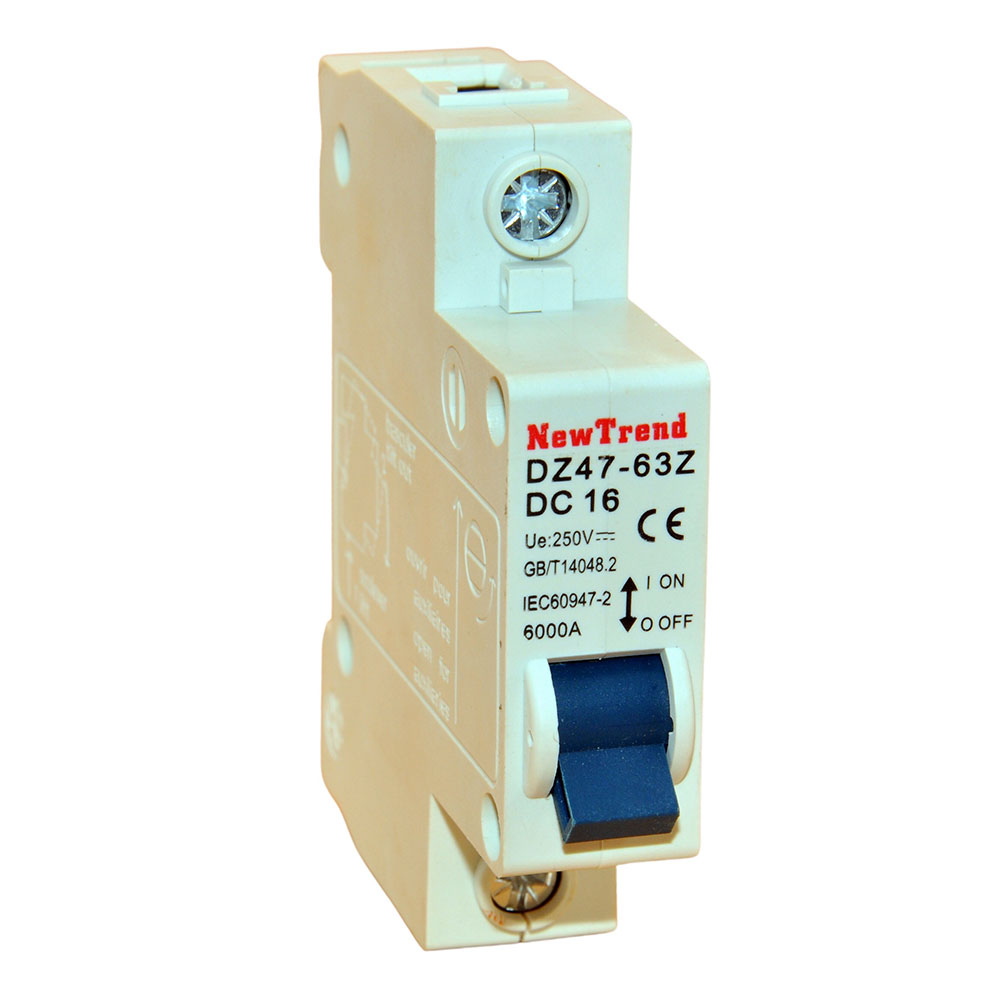
When designing a solar photovoltaic (PV) system, selecting the right circuit breaker isn’t just about amperage ratings—it’s about understanding the fundamental differences between AC and DC protection devices. Using the wrong breaker type can lead to catastrophic failures, fire hazards, and system downtime.
This guide explains the critical technical distinctions between AC and DC circuit breakers and why solar installations demand specialized DC-rated protection.
—
## The Fundamental Difference: Arc Suppression
### Why DC Is Harder to Interrupt
**AC Circuit Breakers:**
– Current naturally crosses zero 100-120 times per second (50/60Hz)
– Arc extinguishes naturally at current zero-crossing
– Simpler arc chute design
**DC Circuit Breakers:**
– Current flows continuously in one direction
– No natural zero-crossing to extinguish arc
– Requires specialized magnetic blowout coils and extended arc chutes
– Arc can sustain at much higher voltages
**Critical Insight:** An AC breaker rated for 600V might only safely interrupt 125V DC. Attempting to use AC breakers on DC circuits creates serious fire risks.
—
## Technical Comparison: AC vs. DC Breakers
| Characteristic | AC Circuit Breaker | DC Circuit Breaker |
|—————-|——————-|——————-|
| Arc Extinction | Natural zero-crossing | Forced magnetic blowout |
| Voltage Rating (typical) | 240V-690V AC | 250V-1500V DC |
| Poles in Series | Not required | Required for high voltage |
| Breaking Capacity | Standard Icu | Enhanced for DC arcs |
| Contact Material | Standard alloy | Silver-plated, arc-resistant |
| Application | Grid distribution, motors | Solar, batteries, EVs |
—
## Solar PV System Requirements
### Why Solar Demands DC Breakers
Modern solar installations face unique challenges:
**High DC Voltages:**
– Residential: 300-600V DC
– Commercial: 600-1000V DC
– Utility-scale: 1000-1500V DC
**Continuous Operation:**
– 8-12 hours daily operation
– 25-year system lifespan
– Outdoor temperature extremes (-40°C to +85°C)
**Bidirectional Current:**
– Normal operation: String current to inverter
– Fault conditions: Reverse current from parallel strings
– DC breakers must interrupt in both directions
—
## Key Selection Criteria for Solar DC Breakers
### 1. Voltage Rating
**Rule:** Breaker voltage rating ≥ Maximum system Voc (cold temperature corrected)
**Calculation Example:**
– Panel Voc at 25°C: 45V
– Temperature coefficient: -0.3%/°C
– Lowest temperature: -10°C
– Temperature correction: 1 + (0.003 × 35) = 1.105
– Corrected Voc: 45V × 1.105 = 49.7V per panel
– 20-panel string: 49.7V × 20 = 994V
– **Minimum breaker rating:** 1000V DC
### 2. Current Rating
**NEC 690.8 Sizing Formula:**
“`
Breaker Size = 1.56 × Isc (short-circuit current)
“`
Where:
– 1.25: Continuous operation factor
– 1.25: Additional safety margin
**Example:**
– Panel Isc: 9.5A
– Strings per breaker: 2
– Total Isc: 19A
– Required rating: 19A × 1.56 = 29.6A → **32A breaker**
### 3. Trip Characteristic Curve
| Curve | Trip Range | Solar Application |
|——-|————|——————-|
| B | 3-5×In | Sensitive electronics |
| **C** | **5-10×In** | **Most solar applications** |
| D | 10-20×In | High inrush loads |
**Recommendation:** C-curve breakers provide optimal protection for solar PV systems, handling capacitor inrush while tripping reliably on short circuits.
—
## Common Application Scenarios
### Scenario 1: String Combiner Box
**System:** 100kW commercial rooftop
– 8 strings × 15A each
– 1000V DC system voltage
**Breaker Configuration:**
– 8× string breakers: 32A, 1000V DC, C-curve
– 1× output breaker: 250A, 1000V DC
– All with 10kA minimum breaking capacity
### Scenario 2: Battery Energy Storage
**System:** 48V DC battery bank
– 4× 12V batteries in series
– 200A maximum charge/discharge
**Breaker Configuration:**
– Main battery breaker: 250A, 125V DC
– Individual string breakers: 63A, 125V DC
– Critical: Bi-directional breaking required
### Scenario 3: Off-Grid Cabin
**System:** 24V DC micro-system
– 4× 100W solar panels
– 200Ah battery bank
**Breaker Configuration:**
– PV input: 20A, 250V DC
– Battery protection: 125A, 125V DC
– Load distribution: 10A-32A, 125V DC
—
## Certification Requirements
### Essential Standards for Solar DC Breakers
| Market | Certification | Key Requirements |
|——–|————–|——————|
| USA | UL 489B | DC rating up to 1000V, PV specific |
| Europe | IEC 60947-2 | General DC performance |
| International | IEC 60898-2 | Residential DC breakers |
| Australia | AS/NZS 4892 | DC specific for solar |
**Warning:** Never use “self-certified” or non-listed breakers. Demand third-party test reports.
—
## Installation Best Practices
### Do’s ✅
– Verify DC voltage rating exceeds maximum Voc
– Use C-curve breakers for most applications
– Install in weatherproof enclosures (IP65 minimum)
– Label all DC circuits clearly
– Include proper arc-fault protection
### Don’ts ❌
– Never use AC-only breakers on DC circuits
– Don’t undersize breaking capacity
– Avoid mixing different breaker brands in same enclosure
– Never install standard breakers in unprotected outdoor locations
—
## Conclusion
The distinction between AC and DC circuit breakers isn’t academic—it’s critical for safety and system reliability. Solar PV systems demand specialized DC-rated breakers with enhanced arc suppression capabilities, appropriate voltage ratings, and proven reliability under continuous operation.
**Key Takeaway:** Always specify DC-rated breakers for solar applications. The cost difference between proper DC breakers and generic AC alternatives is minimal compared to the risks of equipment damage, fire, or system failure.
—
## Product Recommendation
For solar PV applications, our **Chint NB1-63DC Series** provides:
– Voltage ratings: 250V/500V/1000V DC
– Current range: 1A to 63A
– C-curve trip characteristic
– 10kA breaking capacity
– UL 489B and IEC 60947-2 certified
– 25-year design life
**[Request a Quote →]** | **[Download Technical Specifications →]**